Science & Applications
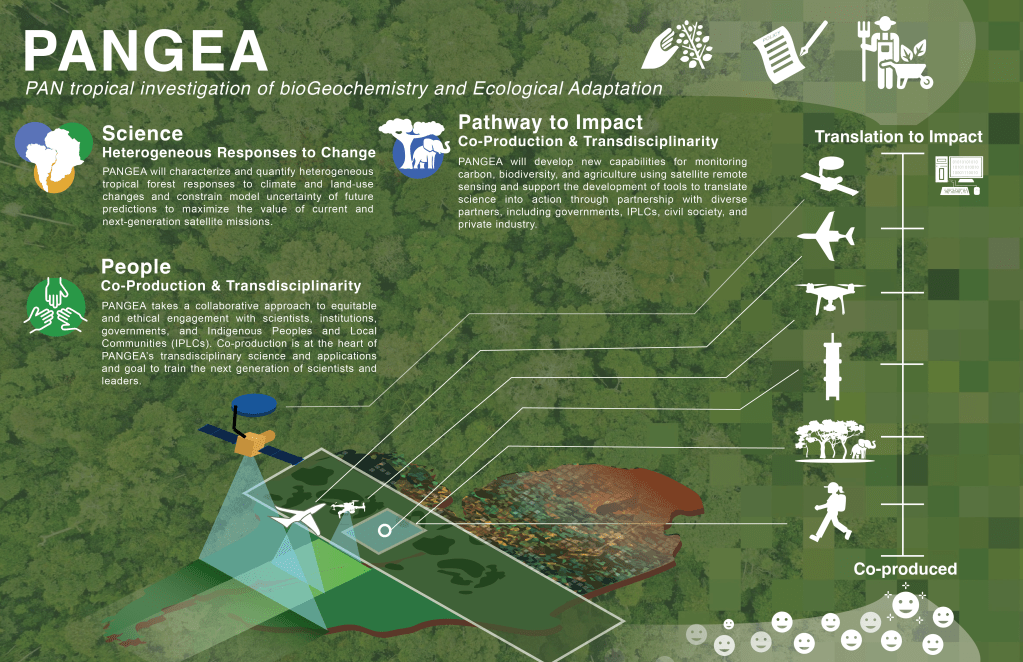
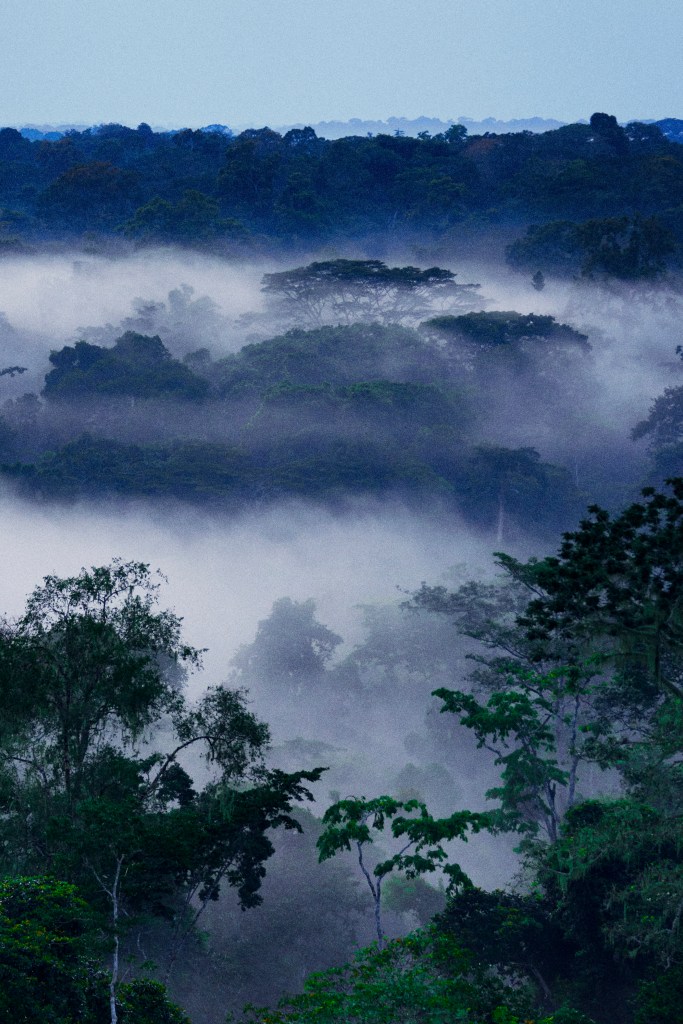
PANGEA will build on the success of NASA’s previous decadal terrestrial ecology campaigns, including the Artic-Boreal Vulnerability Experiment (ABoVE) and the Large-scale Biosphere-Atmosphere Experiment in Amazonia (LBA-ECO) to better understand the combined effects of climate and land-use change in tropical forests within and between continents. To do so, this campaign will combine in-situ field data with remotely sensed airborne and spaceborne data.
Leveraging a transdisciplinary methodology, PANGEA will:
1. Characterize and quantify heterogeneous tropical forest responses to climate and land-use changes.
2. Address calibration, validation, and algorithm development needs to ensure measurements can be accurately retrieved from satellite remote sensing datasets over tropical forests, ultimately advancing the global utility of satellite missions.
3. Constrain model uncertainty of predictions of tropical carbon fluxes and other biogeochemical cycles, biodiversity, and forest-climate feedbacks by improving process understanding and advancing remote sensing data-model integration.
4. Develop new capabilities for monitoring carbon, biodiversity, and agriculture using satellite remote sensing and support the development of tools to translate science into action.
5. Train the next generation of scientists and leaders to continue this work beyond PANGEA.

Funding
PANGEA is currently a scoping study, funded primarily from NASA to UCLA. Below are the rules that describe NASA limitations on foreign funding. We are currently exploring possible exceptions to this rule and identifying additional sources of funding to directly support international collaboration on this scoping effort.
We welcome feedback and suggestions on any opportunities you might know of to fund international collaboration on this project.
From NASA’s Proposer’s Guide, Section 2.2.1.
“In general, per 2 CFR 1800.3, Applicability, research with foreign organizations will not be conducted through grants or cooperative agreements. Typically, NASA conducts research with non-U.S. organizations on a cooperative, no-exchange-of-funds basis. Although Co-Investigators (Co-Is) or Collaborators employed by non-U.S. organizations may identify themselves as part of a proposal submitted by a U.S. organization, NASA funding does not normally support research efforts by non-U.S. organizations and Collaborators at any level, including travel by investigators at non-U.S. organizations. This policy pertains to the nature of the proposing organization and not the nationality or citizenship of the individuals listed in the proposal. However, the direct purchase of supplies and/or services, which do not constitute research, from non-U.S. sources with NASA-awarded funds is permitted.”
PANGEA Tropical Forest Scoping

 PANGEA